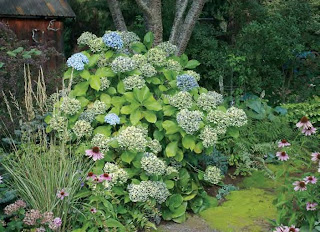
When your cutting garden is becoming too shady for roses, you can replace them withhydrangeas and be just as happy. A partial-shade cutting garden can be built aroundthis versatile plant.Generally speaking, there are two types of hydrangeas mainly used for cutting:the mopheads (Hydrangea macrophylla [Hortensia Group]) and the peegee hydrangeas(H. paniculata ‘Grandiflora’ and near relations), although other kinds are sometimesseen, and many more are sure to follow as Japanese forms of Hydrangea serrata provetheir worth in the trade. The lacecaps (Hydrangea macrophylla var. normalis [LacecapGroup]) are widely grown in gardens but do not have the vase life or impact inarrangements that the mopheads do, and they dry poorly. The conversation herewill confine itself to using the mopheads and peegees as fresh cut flowers and dryingthem, as there seems to be an infinite market for them, and the mophead group comesin the widest array of colors.I spoke of tulips as being unruly, and so are hydrangeas, but for different reasons.Although the peegees are fairly stable as to their color—opening cream and fadingto pink—the mopheads are anything but. The soil pH tells them what color to be,even if they are genetically predisposed to be pink or blue. Acidic soil—called soursoil—with a pH less than 7 (which is neutral) will give you hydrangea heads shadingtoward blue, and pink hydrangeas will shift to lavender. Alkaline soil—known assweet soil—with a pH higher than 7 (the pH scale ranges from 1 through 14), makesblue hydrangeas lean toward pink, equaling more lavender shades. It is possible tohave both pink and blue on one plant, depending on where the roots wander andwhich fertilizers have been used in the garden.This makes hydrangeas a challenge to grow, as it takes several years for the plantsto settle into your soil and show you what their true color will be in it. Again, enjoythe ride, as the plants may produce some gorgeous transitional colors, never to berepeated. Once a plant is well established, you can easily—but not quickly—modifythe color. If you want a pink hydrangea to be pinker, give it calcium carbonate, orgardener’s lime, to further sweeten the soil. For bluer blues, use aluminum sulfate.Overall, mophead hydrangea colors (and this goes for lacecaps, too) range frompurple through any shade of blue; lavender, which tends to be a transitional color;dark to bright pink and cream with a pink outline; reddish—I say it this way becausesometimes a hydrangea beginning its season some other color ages to red; and white,the white being more stable, although as the blooms age the white becomes green orpink, depending on the sun exposure.


