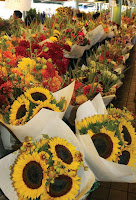
Показват се публикациите с етикет Flowers. Показване на всички публикации

FLOWERING BULB FEEDING AND CARE


To feed your naturalized bulbs, work a good organic compost or well-rotted cow manure into the soil when planting. Then add a 1-inch layer of compost as a mulch each fall.
Alternatively, apply a slow-release bulb food, such 9-9-6, when planting, and again each fall (sprinkle fertilizer over the planting area at the rate recommended on the label).
To maintain your bulbs, avoid cutting back leaves before they have yellowed to allow bulbs to regenerate for next year's flowers. Allow the leaves to grow for at least six weeks after flowering.
Avoid working soil in early spring just as bulb foliage begins to grow and avoid any use of lawn herbicides while the bulb leaves are still green.

WHERE TO PLANT YOUR BULBS


For a flowering lawn, use early, low-growing bulbs such as crocuses, mini-daffodil cultivars such as 'Jack Snipe', 'Tête à Tête' or 'Quail', snowdrops, glory-of-the-snow, scillas and windflowers.
These bulbs create a carpet of color and will tolerate cutting back by the time the grass needs mowing.
Naturalize larger, later-blooming daffodils in areas where mowing can be put off for six weeks after they bloom, for example, along a country lane or shrub border.
A sprinkling of small early-flowering bulbs, such as windflower, crocus, scilla, snowdrop, glory-of-the snow or grape hyacinth, looks wonderful under deciduous shrubs and trees such as ash, birch, cherry, Japanese cherry, oak, fruit trees and profusely flowering crabapples.
Before leafing out, these deciduous trees and shrubs allow for plenty of sunlight early in the season when the bulbs need it.

Bulbs that multiply


The flower bulbs that spread well on their own tend to be the smaller ones.
They include windflowers (Anemone blanda), crocus, guinea-hen flower (Fritillaria meleagris), winter aconite (Eranthis), snowdrop, glory-of-the snow (Chionodoxa).
Also lovely are grape hyacinth (Muscari), daffodils and Siberian squills (Scilla siberica).
Many hybrid tulips, however, can't be counted on to spread: they look spectacular in the first year, but in the following years, their flowers often get smaller and sparser, or the plants disappear altogether, at which point, it's advisable to replace them.
For naturalizing, choose the smaller species tulips, which grow only 6 to 12 inches tall. Try the starry flowered white and gold 'Tarda', the cream and yellow turkestanica varieties, or the lovely canary yellow Tulipa batalinii 'Bright Gem'. They look wonderful at the edge of flower beds, in rockeries and in small gardens.

Early spring garden jobs: In the flower garden


Don't be in a rush to remove winter mulch or to cut back evergreen plants such as lavender until temperatures are reliably warm.
Freeze and thaw cycles over the winter may given some of your plants the heave-ho. Replant any perennials that the frost has heaved out of the ground as soon as you can.
Cut back the previous season's dead plant material. Clean up old perennial foliage from last season (trimmings can go into the compost). Cut back ornamental grasses. (More details on this job and care of grasses.)
Remove winter protection of mounded earth from roses. Prune rose bushes before they start to leaf out. (More information on rose care.)
Resist the urge to start digging in your flower beds too early. You can damage the soil's structure. If you pick up a handful of soil, it should fall apart, not stick together like glue. When it's dry enough, you can start to dig beds and add compost or manure in preparation for planting. (How to get your soil ready for planting.)
Getting on top of the weeding now means a lot less work later. Weeds start growing vigorously early, so when you spot them, go to it because they are easier to pull out while their roots are still shallow in early spring.
Maintain edges. Grass growth is vigorous in the early spring garden, so edge your flower beds with a sharp trench between them and the grass to keep it in bounds. Repeat this job a couple of times through the season or installing permanent edging goes a long way towards having a lower maintenance flower garden.

Daylilies - versatile and easy garden perennials


Daylilies are colorful, easy to grow and will shine in many flower garden conditions. In Greek Hemerocallis, their botanical name, means "beauty for a day" because each individual flower lasts only a day, hence daylily.
google_protectAndRun("render_ads.js::google_render_ad", google_handleError, google_render_ad);
So why grow a plant with flowers that last only a day?
Well, for one thing, an established daylily grows many scapes (flower stems) that produce a profusion of buds that keep the plants in bloom for weeks.
There has been a revolution in daylily breeding over the past few years, resulting in new colors and forms.
The plants are stronger with lots more flowers over a longer period of bloom. There are more than 50,000 registered cultivars.
Gardeners love them for their rainbow of colors (they flower in every shade except blue) and many shapes and sizes.
They make versatile garden plants too: you can have daylilies in bloom from late spring until autumn. A well-established clump produces many buds and new flowers daily for a month or more.
The plants are clump forming, herbaceous perennials with fibrous or somewhat tuberous roots. Grow them in well-drained soil, amended with manure or compost.
For best performance give them full sun, at least six hours of sun a day. If you plant them in too much shade, you'll get more leafy growth with fewer flowers.

Perennial geraniums – planting and care


Many perennial geraniums will grow in zones 4 to 8, and do well in full sun to part shade. When planting, give them enough room for the foliage to spread a distance at least equal to the mature height.
There are no special soil requirements, but drainage must be good. Moist, well-drained soil is ideal, but they will tolerate some drought. Easy to maintain, geraniums are rarely bothered by pest or diseases.
Depending on species and cultivar, plant sizes vary from a few inches to 3 feet tall and come in all shapes – mounds, mats, spreading masses and bushy clumps. Some, like 'Ann Folkard' will even climb and scramble within shrubs or large perennials.

Easy-care plants for your garden


There are plenty of great, easy-care perennials that can be star performers in your garden.
Larry Hodgson, a prolific gardener and author of the best-selling Perennials for Every Purpose has put together a good list of qualities easy-care perennials should have:
Longevity (90 percent alive and thriving five years after planting)
Resistance to disease and insects, so you don't have spray them
Don't need to be divided more often than every four or five years
Tolerance of a wide range of growing conditions
Cold hardy – no winter protection needed
Good tolerance of summer heat
Long blooming period, or foliage that's attractive all season
Won't take over your garden
Don't need to be staked.
That's a lot to ask of a plant. "In fact, it's surprising, says Larry, "how few perennials meet all the easy-care characteristics. Phlox, for example, meets almost all of them except for disease and insect resistance: keeping them mildew-free can be a summer-long nightmare."
He points out that some easy-care perennials like peonies need staking. Many otherwise ideal plants are either invasive – goutweed is a prime example – or tend to disappear after several years – such as lupines and shasta daisies


Colour:Red
Flowering:June - July
Height:Up to 8' (2.5 m)
Family:Escalloniaceae

Escallonia is a native of South America. The leaves are deep, glossy green and the variety we have in the garden is evergreen.
The flowers are tubular with five rounded lobes. They come in a variety of shades of pink and red.
We have found that this shrub thrives in the garden although in more northerly locations it should be planted in a sheltered spot. It is a good hedging plant as it is fast-growing, evergreen and grows well in any well-drained soil.

Cherry Laurel


Colour:White
Flowering:April
Height:Up to 20' (6 m)
Family:Rosaceae
The Cherry Laurel is an evergreen shrub with shiny and leathery green leaves.

It flowers in April, with white spiky florets growing along stems up to 10 cms long. These are followed by small black fruits.
This is a very useful shrub for hedging and screening since it is dense and fast-growing.
Cherry Laurel Water is made from crushed leaves and is used for medicinal purposes.

Callistemon - Crimson Bottlebrush


Colour:Red
Flowering:July
Height:Up to 6' (up to 2 m)
Family:Myrtaceae

Callistemon is an evergreen shrub that was originally introduced from Australia but some species grow quite successfully in Britain.Callistemon citrinus will tolerate temperatures down to -5 degrees C so should be planted in a sheltered spot if there is a risk of temperatures lower than that. We occasionally experience lower temperatures here and those in our garden have survived. The leaves are long, narrow and leathery. The flowers are made up of brush-like crimson spikes (5 - 10 cms long, which as the name suggests, look just like a "bottle brush". A pretty shrub during the few weeks that it is flowering.

Lavandula


Colour:Mauve / blue
Flowering:July - September
Height:Up to 36" (100 cm)
Family:Labiatae


Lavender is a pretty plant, often grown for its fragrant flowers which are dried for pot-pourris and scented sachets.The flowers are mauve/blue and grow on spikes, 4 - 6 cms long. The leaves are grey/green, long and narrow.Lavender is sometimes used for low hedging but does not last long and needs to be replaced after a few years. It likes a sunny spot but is tolerant of most types of well-drained soil.It is also used to treat ailments such as insomnia, anxiety and depression because it induces calming, sedative effects.If you are planning to pick lavender for drying, make sure to pick the flowers before they are fully open.

Tips on dealing with the most common rose health problems


Black Spots On Leaves
This disease is commonly known as black spot. Black spots appear as circular with fringed edges on the leaves, and they cause them to yellow. The solution is to remove the infected foliage and pick up any fallen leaves around the rose. Artificial sprays can be used to prevent or treat this kind of rose disease.
Stunted Or Malformed Young Canes
Known as powdery mildew, this is a fungal disease that covers leaves stems and buds with wind spread white powder. It makes the leaves curl and turn purple. Spray with Funginex or Benomyl to treat this particular disease which could totally ruin your rose garden.
Blistered Underside Of Leaves
A disease of roses known as rust, it is characterized with orange-red blisters that turn black in fall. In spring it will attack the new sprouts, and this disease can even survive the winter. What you should do is to collect and discard leaves that are infected in fall, and also spraying Benomyl and Funginex every 7-10 days will help.
Malformed Or Stunted Leaves And Flowers
The one most likely cause of this is the presence of spider mites. These are tiny yellow red or green spiders which cling to the underside of the leaves. They will suck the juices from the leaves, but the application of Orthene or Isotox may help in treating this infestation.
Weak And Mottled Leaves Showing Tiny White Webs Underneath
This might be caused by aphids, which are small soft-bodied insects which are usually brown green or red. Often found clustered under leaves and flower buds, they suck plant juices from tender buds. However Malathion or Diazinon spray may help roses to survive these bugs.
Flowers That Do Not Open Or Are Deformed When They Do Open
Thrips could be the reason behind this deformation and unopened flowers, which is characterized with slender brown-yellow bugs with fringed wings thriving in the flower buds. They will also suck the juices from the flower buds, so therefore you should cut and discard all infested flowers. Using Orthene and Malathion will also treat this health problem with your roses.

Daylily planting and care tips


Planting: The best time to plant daylilies is in spring or autumn, but if you buy container-grown plants you can plant them out any time during the growing season. Just avoid periods of drought, unless you are prepared to water your new plants faithfully.
Improve your soil by working in some compost in before planting. Recommended planting distance is 18 to 24 inches apart. Your planting hole should be a little larger than the root mass.
The crown (band of white on the foliage) is the indicator for depth as this should be just below the surface. Set the plant so that the crown is no deeper than inch below the surface of the soil. Firm the soil after planting, using your hands (pressing or stomping with your feet can cause root damage).
Watering: Water plants thoroughly after planting, and continue to deep soak them at least weekly until established (about six to eight weeks). Although daylilies are drought-tolerant once established, consistent watering while they are budding and flowering will produce better-quality flowers.
Mulching and fertilizing: Mulch your daylily beds with compost in spring. Avoid giving daylilies high nitrogen fertilizers as this promotes more foliage growth at the expense of flowers. Fertilizers with 5-10-15 and 6-12-12 are low in nitrogen and provide good ratios of phosphorous and potash.
google_protectAndRun("ads_core.google_render_ad", google_handleError, google_render_ad);

Building the basic nosegay


Here are three basic ways to start a nosegay:

1. Start with a flower head that is already shaped in the basic nosegay form, such ashydrangea or Sedum ‘Autumn Joy’.

2. Start with the type of flower you have the most of and form the blossoms into adome.

3. Start with one perfectly splendid flower, which you will keep at the apex of thedome while building the rest of the nosegay around it (as best you can).

Even before attempting any of these methods, because you are building this bouquetin your hand, you will want to have all of the stems—flowers, fillers, fruit, andfoliage—ready. The circle you make by touching thumb with forefinger is your imaginaryvase opening. As you build your nosegay, the stems will be below this circle andthe nosegay will rise above it. All the stems hanging below your thumb and forefingershould be clean—because any foliage left on the stems would be beneath the watersurface when the nosegay is placed in its vase.The nosegay is best built in one hand while being added to by the other. Whicheveris your less nimble or “off” hand becomes the “vase hand.” Its job is to createthe circle and hold the flowers, while your other hand adds elements. With one handholding your burgeoning bouquet, you should never stop in the middle of productionto do a task requiring both hands. Laying down a nosegay midway through is a bigrisk—you may not get the flowers back the way you had them. I always try to be sureeverything is in readiness, so that once I launch into making a nosegay, I can proceeduninterrupted to its completion.If you cook, think of this as making a stir-fry in a wok. There is a lot of cutting andchopping to do beforehand, and you do not put the heat on until all of the ingredientsare arranged around you. This is the most time-consuming part of the process. Onceyou start cooking, a stir-fry is prepared quickly. Nosegays are the same.The cooking analogy ends here. Although most floral instruction books speak ofrecipes for floral design, I take a more improvisational approach. You never knowexactly what your garden will present. If you go to gather flowers believing you musthave three of this and five of that, you may be disappointed. Instead, you may findit more helpful to think of color and/or shape elements rather than specific typesof flowers. For instance, rather than insisting on three stems of pink sweet william(Dianthus barbatus), you must be willing to assess your options in case you find onlyone of good quality. One pink rose, one sweet william, and one pink annual pincushionflower (Scabiosa atropurpurea) will give you three forms in pink, and perhaps amore interesting final result. Be open to making midharvest adjustments.No matter which of the three basic nosegay construction methods you chose, it allgoes together in roughly the same way:
first, big flowers
second, filler flowers and delicate, easily broken flowers
third, foliage collar

Basic Bouquets


Keeping floral arrangements simple is the best way to build yourconfidence as you begin to design with your own cut flowers. The more mechanicsyou assemble into an arrangement (floral foam, chicken wire, floral tape and the like),the more you have to hide your tracks to make the complex construction appeareffortless and natural. Taking a simple composition of one or two types of flowerswith one or two types of foliage in your hand, tying it with jute twine, and selectingan appropriate vase will always result in an outcome with more charm than an overlyambitious and obvious fabrication. Flowers in containers should look magical, andthe hand of the designer should appear light and easy, if it appears at all.

Emotional effect and meaning


“Cute” has to have the courage of its convictions. Merely cute is never enough to bememorable, and may, in fact, be annoying. If your taste leans toward cute, then youmust pursue “cute as a button” and nothing less. The inherent lightheartedness of acute flower arrangement is just one example of the emotional effect you may want tocreate with your garden and the bouquets you generate from it. Others see cute ascloying—those folks are jaded and cynical, the real flower snobs. Serenity, romance,festivity, intrigue are all states of mind evoked with the simplest combinations of flowersand foliage, in the ground or in a vase.An emotional response to cuteness is just one of a legion of emotions we can evokewith flowers, in this case inspired by flowers that are little and lovable. The oppositeend of the spectrum would be the maiming of flowers to evoke anger and hatred. HereI am remembering the unfortunate 1980s fad of sending a newly divorced spouseor ex-companion flowerless thorny rose stems—or, in the same vein, roses that hadpurposefully been left out of water to become limp, well beyond the point of beingrevived, and sprayed black. If one were the recipient of such a bouquet, there wouldbe no mistaking the message.In the back of the book you will find a list of the meanings of flowers, handed downthrough the ages in folklore or created in more modern times by marketing experts.The latter have both concocted meanings for flowers that never had them beforeand changed the significance of flowers that have historically carried a negative message.An example of this is the yellow rose. Traditionally it symbolized jealousy; therecipient was engaging in behavior engendering envy and insecurity in the sender.Sometime in the 1920s we began reading in advertisements that yellow roses werethe symbol of friendship; the sender either wished to become friends with the recipientor to state plainly their relationship. Suddenly yellow roses enjoyed a boost inpopularity.Herbs and cottage garden flowers were sometimes given their meanings based onhow they grew and were used domestically. The “doctrine of signatures” suggestedthat plants that looked like a part of the body would help that part when prepared formedicinal use, and thus certain plants became associated with the heart or anotherorgan that might have been perceived to be the seat of certain emotions.Plants that spread rapidly from seed or were tough and enduring came to symbolizehuman personality attributes—or deficits, as the case may be—in the language offlowers. For instance, alliums, the ornamental and culinary onions, because of theirstrong odor and ability to withstand many types of garden conditions came to symbolizecourage. Common sunflowers (Helianthus annuus), by virtue of the fact thattheir blossoms follow the sun as it makes its high arc over the summer garden, cameto be associated with loyalty.Romantic meanings for flowers gained currency in a time when lovers were oftenthwarted and controlled by the prevailing moral standards. Except with family andin the company of servants (both being situations thought safe from impropriety),young men and women having any social standing were not left alone together. Therewere chaperones abounding, and they could only be circumvented by carefully composednosegays, each flower and leaf fraught with meaning, pressed into the hand ofthe beloved secretly in passing, or delivered through a trail of servants, relatives, andfriends. Flowers delivered proposals and broke off engagements with the precisionof a telephone call and were always beautiful even if the intended message was mostdecidedly not. Only in our modern times have innocently grown flowers been madehideous to unmistakably convey darker meanings.

Color makes emotion2


Creating bouquets with mixed colors, as long as the relative strength of hue isthe same, always strikes me as festive and stimulating. Others prefer monochromaticcombinations, where tones vary only slightly from flower to flower; the effect is morecalming and, some would say, elegant. Depending on the context of such an arrangement,I might also find it boring. Still others might want the simple contrast of justtwo opposing colors—yellow and blue, purple and orange—to set in motion a pleasingvibration that will be bright but will not clash.Here are some color terms that you might find useful to know and that will helpyou better communicate your preferences.

secondary colors: Secondary colors are those three colors created by blending thethree primary colors together: green (blue + yellow), orange (red + yellow), andviolet (red + blue).

spectrum: The spectrum is the immutable order of light wavelengths producingvisible color as sunlight passes through the earth’s atmosphere (red to orange toyellow to green to blue to indigo to violet). It starts with infrared and ends withultraviolet.

tint: A tint is created when white is added to a fully saturated color (for instance, red+ white = pink).

tone: Tone is the measurement of brightness (lightness or darkness). Violet has adark tone, yellow has a light tone. White and black are tonal extremes.warm colors: Warm colors fall into the red-influenced half of the color wheel andinclude all tones of red, orange, yellow, gold, and the hot pinks.

wavelengths: Color is created by light from the sun traveling through our atmosphereat various speeds. The shorter (faster = shorter) the wavelength, thebrighter the color. Red is fast (has a short wavelength), blue is slow (has a longerwavelength).

white: White is the combination of all color wavelengths and so does not appear ina spectrum.

Color makes emotion1


Nowadays color is the carrier of emotion, not the specific type of flower. Red is vividlypassionate and conveys the strongest statement of love. We may think first of redroses, but any bouquet predominantly red can carry the message of intense feeling.Modern red roses may be stiff and are commonly presented in a formal way, but abouquet of fiery tulips says the same thing: “I adore you, and your beauty renders mespeechless. I can only tell you with flowers.”Yellow, while gaining momentum as the color of friendship and sociability, is stillburdened by visions of jealousy and lost love. In the nineteenth century, yellow wasthe color that expressed having “the blues.” Although we now associate yellow withwarmth and cheer, as well as intelligence and a lively mind, this ancient burden ofsadness has never fully been transferred to blue. After the reign of the sunflower as adecorating motif in the 1990s, there is no getting around it: in our current age yellowis primarily thought to be the color of sunlight, stimulating our eyes and lifting ourspirits.Having “the blues” is a relatively modern concept. Blue is also the color of healingand serenity. It is the family of hues least stimulating to the color sensors in our eyes,and we can look at shades of blue for a much longer period than mixed tints of redor yellow. It is the traditional color of forgiveness (spouses in the doghouse woulddo better to send ten blue iris than a dozen red roses, whose color further might stirthe ire of a wronged mate), and when the merest touch of red is added, blue becomesthe color of enchantment, purple. Blue must be pure to photograph well, and thehuman eye is easily fooled into seeing blue where it does not exist, as in the feathersof birds.Creating bouquets with mixed colors, as long as the relative strength of hue isthe same, always strikes me as festive and stimulating. Others prefer monochromaticcombinations, where tones vary only slightly from flower to flower; the effect is morecalming and, some would say, elegant. Depending on the context of such an arrangement,I might also find it boring. Still others might want the simple contrast of justtwo opposing colors—yellow and blue, purple and orange—to set in motion a pleasingvibration that will be bright but will not clash.Here are some color terms that you might find useful to know and that will helpyou better communicate your preferences.

black: Black is the absence of any color wavelength and does not appear in a spectrum.

color-sensitive cells: There are three types of color-sensitive cells in the humaneye, all known as cones, each responding to one of the three primary colors.Rods detect only differences in tones (amount of light as compared one color toanother).

color wheel: A color wheel is a circle of colors formed by taking a linear spectrumand connecting the ends. This wheel helps us visualize which colors are in whichprimary groups, what harmonizes and what contrasts.

contrasting colors: Contrasting colors are those colors that lie on opposite sides ofthe color wheel from each other (for example, orange and purple).

cool colors: Cool colors fall into the blue-influenced half of the color wheel andinclude all tones of blue, purple, violet, and green.

harmonious colors: Harmonious colors are those colors that are adjacent to eachother on the color wheel (for example, purple and blue).

hue: A hue is created when black is added to a fully saturated color (for instance,blue + black = navy blue). This term is often used interchangeably with shade.

pastel color: A pastel color is created when a saturated color is diluted by 50 percent(or more) white.

primary colors: The three primary colors—that is, those basic colors found in theirpure form in nature—are red, yellow, and blue. All other colors are combinations,tints, or hues of these three colors.

saturation: Saturation refers to the intensity of a color. The more pure a coloris, the greater its intensity or saturation. The level of saturation is changed in gardensby blending colors with lighter, darker, or variegated companions.

Summer’s flowers and fruit


When your own garden cannot produce enough flowers for a truly stupendous partywithout itself being too much diminished, how nice it is to turn to the farmers’ marketsfor an extra bunch of this or that, or to find a type of flower that is pleasantly earlyor late for its season, making an unexpected appearance. Thanks to farmers’ markets,beautiful arrangements are assured with flowers picked at the perfect time that havenot been stressed by being shipped great distances.Summer is when the annual plants step to the forefront of our gardens. Whetheryou grow them in rows in a cutting garden, sprinkled throughout perennial bordersto invigorate the summer doldrums, or in mixed containers as color spots on terracesand patios, many annuals yield excellent cut flowers. The stalwarts of the basicsummer planter—marigolds, petunias, lobelia, alyssum, coleus, creeping zinnias—allmake reasonably good cut flowers, although not phenomenally long lasting.In mid-to-late summer we start to see the beginning of the harvest from thoseplants that provide berries and fruit for cutting. This group includes the berried St.John’s worts, such as Hypericum ×inodorum ‘Elstead’, and the first clusters of grapeson Vitis vinifera ‘Purpurea’. Branches of apples or pears carrying immature fruit arewonderful in summer bouquets. Even the vegetable garden can be utilized, includingleaves of Swiss chard (excellent in water but not long lasting in foam) and the flowersand ripening pods of scarlet runner beans. The seedpods of the wild perennial sweetpea (Lathyrus latifolius) are in several ways more appealing to cut than the short-livedflowers—you keep this determined weed from spreading by seed, and the attractiveslender pods have a much longer vase life than the flowers do. I also suggest growingthe hyacinth bean (Lablab purpureus) both in the vegetable garden and as a decorativeelement in a mixed perennial border.The hyacinth bean is named for its large flowers, but these are rarely harvested touse fresh because the following bean pod, which is shiny and dark purple, is so veryshowy. When growing this plant from seed, be aware that not all of the plants will beequally decorative, due to natural genetic variation. The seedlings that will producethe most prolific purple pods will often show purple coloration on their stems andpurple veining on their leaves. These are the plants to keep. Thin out those youngplants that are all green, as their eventual pods will be dull in color (sometimes noteven purple at all). The cut pod stems will last more than two weeks in fresh water anddo not like cold storage. The pods develop at the height of summer’s sun and heat,and if held in a cooler will quickly mildew.Summer is the main wedding season, so it follows that it is also the season of anniversarycelebrations. Summer parties are often held outdoors either at homes or atcommercial spaces featuring well-tended gardens. Some think that special occasionsheld in gorgeous gardens do not need the further adornment of floral arrangements,but why should this be? Why not add to the opulence and festivity of an event byhaving floral bouquets at key locations—a nosegay in the powder room, a bombasticbouquet on a buffet table, a standing champagne cooler bursting with flowers markingthe entrance to a pathway, or a welcoming display on a guest book table.Not every garden has an adorable handcrafted chapel on the premises, but at KinzyFaire, the garden of Penny Vogel and Millie Kiggins, Millie has built a memorial chapelhonoring her grandparents, who were the original homesteaders of the propertyoutside of Estacada, Oregon. When the garden has guests the chapel doors are open,and the tiny church (seating fifty if all are good friends) houses the garden’s guestbook, which you are expected to sign if you want to be invited back. The Victoriantable is an ideal spot for a summer bouquet, arranged in colors that are enhanced bythe warm tones of the wooden walls. All of the flowers and foliage can come right infrom the surrounding garden (after proper conditioning, of course).

Ravishing roses


Whether you grow modern Hybrid Tea roses or old garden roses, you will want toget the best out of them when you harvest for the house, and in addition to all of theirfoibles as garden plants, roses have very specific needs when they become cut flowers.Rose addicts generally fall into two camps: those who love the barely opening budand those, like me, who swoon at the feet of a fully double, completely open blossom.Both styles have special requirements for their handling.The roses arriving from florists are generally greenhouse types that would notsurvive long in gardens colder than zones 8 to 9. Even in the balmier regions ofCalifornia these roses are grown under glass to completely control their environment—after all, this is a cash crop. It is hard for U.S. rose growers to compete withgrowers in South America. Roses love light, and at the right elevations at the equator,the flowers of a cultivar like the red rose ‘Forever Yours’ will have gigantic flowersatop stems like Louisville Sluggers. Aside from the politics and environmental considerationssurrounding imported flowers, one cannot deny the amazing size of Southand Central American roses.Here are a few of the greenhouse rose varieties I know to be remarkable:‘Black Baccara’: This is as close as the breeders have come yet to a naturally blackrose. The outer guard petals are deeply dark, but as the blossom unfurls, itreveals interior petals more burgundy red. I once did a stunning bridal bouquetfor a young woman in love with red, including open blossoms of ‘Black Baccara’,‘Charlotte’, and ‘Opium’ roses, and the blended shades of red were divine, as allhad the same dull sheen of old velvet.‘Blue Bird’: Rich lavender in color, this is a much improved version of good old‘Sterling Silver’, which, after all these years, is still grown by a few Californiagrowers. The lavender roses tend to have a fulfilling fragrance. Unfortunately, forgenerations lavender roses have been known to attract mildew diseases, both inthe greenhouse and the garden. More than fifty petals.‘Charlotte’: If you want a truly red rose, ‘Charlotte’ is hard to beat. Mild fragrance,but a satiny sheen to the opening interior surface of the petals loads these flowerswith drama. This is a rose blossom that does not get huge, which can be a goodthing. The bigger the bud, the higher the price.‘Cool Water’: Another improved lavender rose, this one has paler color than ‘BlueBird’, and very round buds. The color is highly affected by climate, and youwould not know that a stem of this cultivar grown in Oregon was the same as astem from Ecuador.‘Katrina’: If you like pink roses, this is one to special order. ‘Katrina’ has longelegant buds of creamy pink, with the color intensifying at the petal edges. Thisis a long blossom, and slow to open.‘Opium’: The shape of this rose is boxy rather than elongated, which is an indicatorboth that the open petals will be slightly ruffled at their edges and that there willbe many of them. ‘Opium’ is a rich dark shade of red, striking the middle groundbetween true red ‘Charlotte’ and dark ‘Black Baccara’.‘Sahara’: This rose is the color of sand, beige and cream and even slightly peachy,and exquisite. The flowers unfurl from the tips outward, revealing a stronglyspiraled center. The blossom opens fairly quickly but will hold itself at perfectmaturity for at least a week. Thick, old rose fragrance. If I were getting marriedagain tomorrow, this is the rose I would have, combined with ‘Queen of theNight’ tulips. Oh, yummy.‘Skyline’: This is my favorite yellow cut rose. The color is buttery and soft. ‘Skyline’has lots of petals and stays beautifully in the plump bud stage for several daysbefore opening. Light fragrance.